The Ethereum Emporium: Blockchain Market
completedA real-time collaborative whiteboard application for remote teams and creative brainstorming.
Tech Stack



Overview
The Ethereum Emporium is a Web3.0-based decentralized marketplace that enables users to buy and sell products directly with each other on the Ethereum blockchain. Unlike traditional e-commerce platforms, all transactions are executed and verified on-chain using smart contracts, ensuring transparency, immutability, and trustless exchanges.
User accounts are linked via MetaMask, and every purchase, sale, and ownership transfer is handled through Ethereum transactions. The project serves as a hands-on exploration of how modern e-commerce concepts can be reimagined using blockchain technology.
Key Features
-
Decentralized Marketplace
Peer-to-peer buying and selling without centralized intermediaries. -
Ethereum Smart Contracts
All product listings and transactions are executed on-chain using Solidity. -
MetaMask Wallet Integration
User authentication and payments handled via Ethereum accounts. -
Trustless Transactions
Ownership transfers and payments verified directly by the blockchain. -
Web3 Frontend Interface
Interactive UI connected to the Ethereum network using Web3 libraries.
Why I Built This
Most large-scale e-commerce platforms today still operate on centralized systems. However, blockchain-based commerce introduces new possibilities such as trustless payments, immutable records, and decentralized ownership.
The goal of this project was to:
- Deeply understand how blockchain transactions work
- Learn how smart contracts manage trades and verification
- Apply blockchain concepts to a real-world use case (e-commerce)
- Bridge frontend applications with decentralized backends
Building a marketplace felt like the most practical way to apply blockchain theory to a tangible, production-style product.
System Architecture
High-Level Architecture
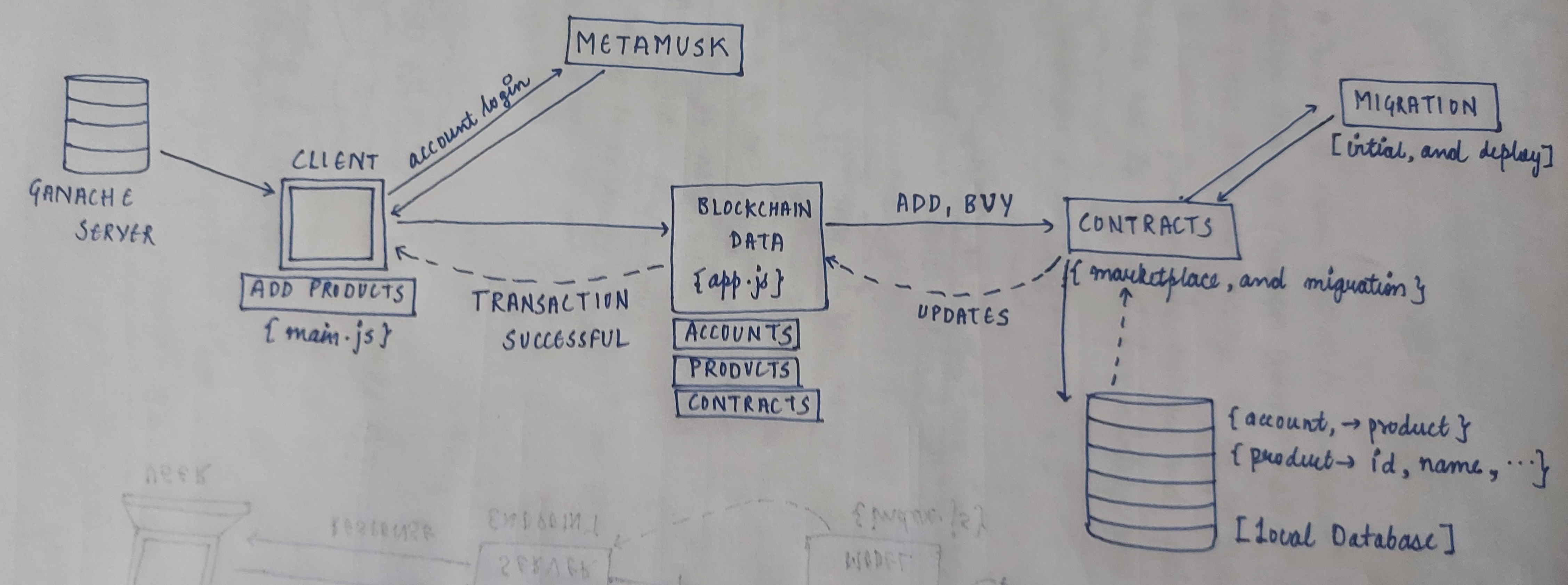
Architecture Breakdown
-
Frontend Layer
- Displays products, prices, and transaction states
- Initiates blockchain transactions via MetaMask
- Listens for transaction confirmations and updates UI
-
Web3 Interaction Layer
- Connects the frontend to Ethereum via MetaMask
- Handles wallet connection, account selection, and gas fees
-
Smart Contract Layer (Backend)
- Written in Solidity
- Manages product listings, purchases, and ownership
- Validates transactions and enforces business rules
- Executes securely on the Ethereum Virtual Machine (EVM)
-
Blockchain Network
- Ensures immutability and verification of all transactions
- Stores transaction history permanently
- Prevents unauthorized data manipulation
Technical Implementation
Smart Contracts (Backend)
- Developed using Solidity.
- Defined structures for products, sellers, and buyers.
- Implemented functions for:
- Listing products for sale
- Purchasing products using Ether
- Transferring ownership upon successful payment
- Enforced validation logic to prevent invalid transactions.
- Deployed contracts to a local Ethereum environment during development.
Blockchain & Wallet Integration
- Integrated MetaMask for:
- Account authentication
- Transaction signing
- Ether transfers
- Used Ganache for local blockchain testing and development.
- Connected Ganache test accounts to MetaMask for realistic simulations.
Frontend
- Built a Web3-enabled UI to interact with smart contracts.
- Triggered contract methods directly from the frontend.
- Displayed transaction status (pending, confirmed, failed).
- Ensured a smooth UX despite blockchain confirmation delays.
Development Stack
- Solidity – Smart contract logic
- Ethereum Network – Transaction execution
- MetaMask – Wallet & authentication
- Ganache – Local blockchain testing
- Web3.js / Ethers.js – Blockchain interaction layer
- JavaScript + Web UI – Frontend interface
Launch & Impact
- Successfully built a functional decentralized e-commerce marketplace
- Enabled real Ethereum-based transactions via MetaMask
- Demonstrated end-to-end Web3 product flow:
- Wallet → Smart Contract → Blockchain → UI
- Served as a practical learning foundation for blockchain-based system design
Learnings
- Gained a strong understanding of Ethereum smart contract architecture
- Learned how transactions are created, validated, and added to the blockchain
- Understood how wallets interact with decentralized applications
- Learned to configure and connect Ganache accounts with MetaMask
- Improved ability to debug smart contracts and blockchain interactions
- Learned how frontend and blockchain backends communicate asynchronously
- Developed patience and discipline working with immutable systems
Challenges Faced:
- Understanding Solidity transaction validation logic
- Connecting Ganache accounts to MetaMask
- Configuring seamless communication between frontend and smart contracts
These challenges were overcome through Solidity documentation, Web3 resources, and hands-on experimentation.